Triage Nurses – Speed dating and acronym specialists!
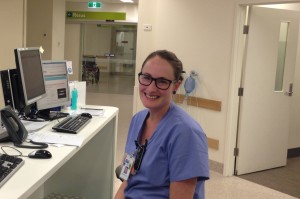 As far as first impressions go, the triage nurse in a children’s emergency department has to be really good. But here we’re talking medical. These highly trained nurses in a busy emergency department have to quickly assess every child that comes through the door. They note parent’s outfits, languages, sizes, shapes, the cultural differences -some will demand immediate care, some cry, some wail, some are overly polite, some indifferent – and primarily focus on the medical first impression of the child. Lynn (reluctantly photographed) has done this for 10 years. When this was taken she was working until 0200 on a particularly busy night(emergency departments always fire up late in the day).
She and several other highly trained nurses listen to half a dozen stories an hour and carefully assess a variety of clinical clues to ascertain which is the next destination for each child. Often it only takes a few seconds to realise something needs to be done.
For example an infant comes in with a cough and Lynn will eyeball the infant to get those first impressions. Things like, alertness, colour, spontaneous movement, hydration, how the breathing looks, rate of breathing per minute, pulse rate and temperature. Based on this initial impression the infant will be categorised from 1 to 5. The first category is the most serious, with immediate treatment commenced such as getting help, setting up oxygen and getting intravenous access – a team affair. The categories move down to 4 and 5, which is where the majority are assigned. These groups have reasonably ok first impressions but still need a full history and examination by a doctor. Often these 4s and 5s will have to wait several hours to be seen, (which causes parents a great deal of frustration) as the unwell categories 1 – 3 will take the priority.
These nurses have their own language, a shorthand for efficiency. A typical assessment will read as follows.
Patient XYZ – aged 9 months female – presents with cough and fever
Assessment – Alert, temp N MMM, UOAM, Incr WOB, NCRT Category 3.
MMM – moist mucous membranes (hydration)
UOAM – use of accessory muscles (these are the muscles recruited when we are short of breath)
WOB – work of breathing
NCRT – normal capillary return
These nurses do an amazing job at dealing with the chaos of an emergency department and perhaps should have an international Triage Nurse Day, or as they would say ITND. But I think they would prefer International five minutes because that is really all they have time for.
SKILLS NEEDED FOR TRIAGE NURSE
1. Exceptional clinical skills
2. Able to work godawful hours
3 Great with all cultures and people
4. Able to work with all types of doctors !
5. Caring and supportive even at 0100 in the morning
6. And of course a sense of humour.