
Child Health
  • GENERAL
    • ANTIBIOTICS
    • IMMUNISATION
    • NUTRITION
    • TEETH CARE IN CHILDREN
  • UNWELL CHILD
    • WHEN TO TAKE YOUR CHILD TO HOSPITAL
    • FEVER
    • FEBRILE CONVULSIONS
    • COUGH
    • ABDOMINAL PAIN
    • VOMITING
    • HEADACHE
  • ILLNESSES/CONDITIONS
    • COLDS & UPPER RESPIRATORY TRACT INFECTIONS
    • RESPIRATORY PROBLEMS
      • COUGH
      • CROUP
      • WHEEZE IN 1-5 YEAR OLDS
      • BRONCHIOLITIS
      • PNEUMONIA (CHEST INFECTION)
      • ASTHMA
    • GASTROINTESTINAL
      • VOMITING
      • GASTROENTERITIS
      • SUDDEN ABDOMINAL PAIN
      • RECURRENT ABDOMINAL PAIN IN CHILDREN
      • CONSTIPATION & ENCOPRESIS
      • COELIAC DISEASE
    • EARS & THROAT
      • MIDDLE EAR INFECTION (OTITIS MEDIA)
      • TONSILITIS AND PHARYNGITIS
      • UlLCERS, SORE THROAT AND FEVER IN TODDLERS
      • SNORING
      • SWIMMER’S EAR – OTITIS EXTERNA
    • SKIN
      • ECZEMA, CAUSES, TREATMENT & ADVICE
      • URTICARIA AND HIVES IN CHILDREN
      • WARTS
      • MOLLUSCUM CONTAGIOSUM
      • VIRAL RASHES
      • IMPETIGO OR SCHOOL SORES
    • GENITOURINARY
      • ‘ITCHY UNCOMFORTABLE GENITAL REGION’
      • URINARY INFECTION
      • BED WETTING
    • CENTRAL NERVOUS SYSTEM
      • FEBRILE CONVULSIONS
      • HEADACHE
  • INFANT
    • ADVICE TO NEW PARENTS
    • GUIDELINES TO INTRODUCING SOLIDS IN INFANTS
    • INFANT FEEDING PROBLEMS
    • HELP WITH INFANT SLEEP
    • IRRITABLE INFANT
  • MENTAL HEALTH
    • AUTISTIC SPECTRUM DISORDER
    • ANXIETY DISORDERS
    • ATTENTION DEFICIT DISORDER
    • BEHAVIOUR AND PARENTING
      • MANAGING THE TODDLER AND SMALL CHILD
      • OLDER CHILD & ADOLESCENT
      • GUIDELINES FOR ONLINE BEHAVIOUR – AAP
  • ALLERGIES
    • ECZEMA
    • ASTHMA
    • DUST MITE ALLERGY
    • FOOD ALLERGY
    • ALLERGIC RHINITIS
    • SUBLINGUAL IMMUNOTHERAPY
  • HEALTH PROFESSIONALS
    • Useful Paediatric Resources
  • Click to open the search input field Click to open the search input field Search
  • Menu Menu
You are here: Home1 / Ears & Throat2 / Ulcers, Sore throat and fever in toddlers
Ears & Throat

Ulcers, Sore throat and fever in toddlers
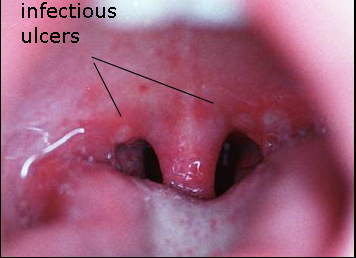
Ulcers, sore throat and fever

This condition (also called herpangina) is an infectious illness that results in ulcers or blisters on the back of the throat or palate. It occurs predominantly in small children and is associated with a high fever for a few days

What is it?

This is an infectious illness caused by a number of viruses. These include a family of viruses called enteroviruses. It used to be thought that the herpes virus was the main cause but this has been shown to be incorrect, but the name still exists.  This is extremely common illness from 12 months of age until around 4yrs.  It is  quite infectious. Luckily apart from some very rare cases this is an illness that is no
Herpangina

t serious.  The illness will last 3 -5 days and during this time should be kept at home.  The virus is excreted in the faeces and good handwashing will prevent its spread.

What are the symptoms ?

Usually the toddler will develop a temperature, go off his or her food and appear upset when swallowing or feeding. There maybe some drooling and high fevers up to 40 degrees and he or she will appear listless.  Sometimes there might be a slight runny nose and some loose bowel actions.  The nighttime can be problematic as the temperature will cause interrupted sleep and the throat will be painful to swallow. Older children may complain of a headache and abdominal pain.  In some cases there maybe a viral type rash on the trunk or the nappy region.

What will the Doctor see ? 

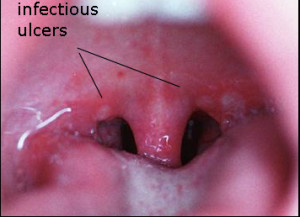
The toddler will usually have a fever, there will be some slightly enlarged lymph nodes around the neck region or under the lower jaw. Often there is drooling.  The throat will have circular ulcers, usually at the back, but sometimes on the palate aswell.  See Picture.  This is not the typical appearance of tonsillitis.

What is the treatment and advice ? 

Being a virus antibiotics are of no value and should not be used.  There are no specific medications that will help eliminate the infection. Most importantly is keeping the toddler comfortable. This will involve some iceblocks, ensuring adequate fluid intake and some panadol or nurofen particularly when going to sleep.

Other facts ? 

  • This is a quite infectious illness and proper handwashing will go some way to prevent spread.
  • If there is a sudden deterioation, it is worth getting reviewed to check there are no complications such as an ear infection.

  • Very very rarely these viruses can have some serious complications. This equates to a handful of cases in Australia each year.
  • They can trigger febrile seizures in those children who are susceptible.This condition (also called herpangina) is an infectious illness that results in ulcers or blisters on the back of the throat or palate. It occurs predominantly in small children and is associated with a high fever for a few days.

Print Friendly, PDF & Email
April 14, 2014/by scott
Share this entry
  • Share on Facebook
  • Share on X
  • Share by Mail
https://childhealth.com.au/wp-content/uploads/2014/04/Herpangina.jpg 258 356 scott http://childhealth.com.au/wp-content/uploads/2013/11/childhealthlogo.png scott2014-04-14 13:12:472019-11-30 12:23:57Ulcers, Sore throat and fever in toddlers

Categories

Dr Scott Parsons

The author, has worked as a general practitioner with a special interest in paediatrics for the last 20 years. He has developed this website in order to help parents with the task of raising children. He currently works in Adelaide at Total GP Care Norwood and Priorty Paediatrics

Affiliations

The website content is based on evidenced based guidelines. There are no commercial affiliations.

Child Health © 2014. All Rights Reserved.
  • Privacy Policy and Disclaimer
Link to: Parenting Discussion Link to: Parenting Discussion Parenting Discussion Link to: Managing The Toddler And Small Child Link to: Managing The Toddler And Small Child Managing The Toddler And Small Child
Scroll to top Scroll to top Scroll to top